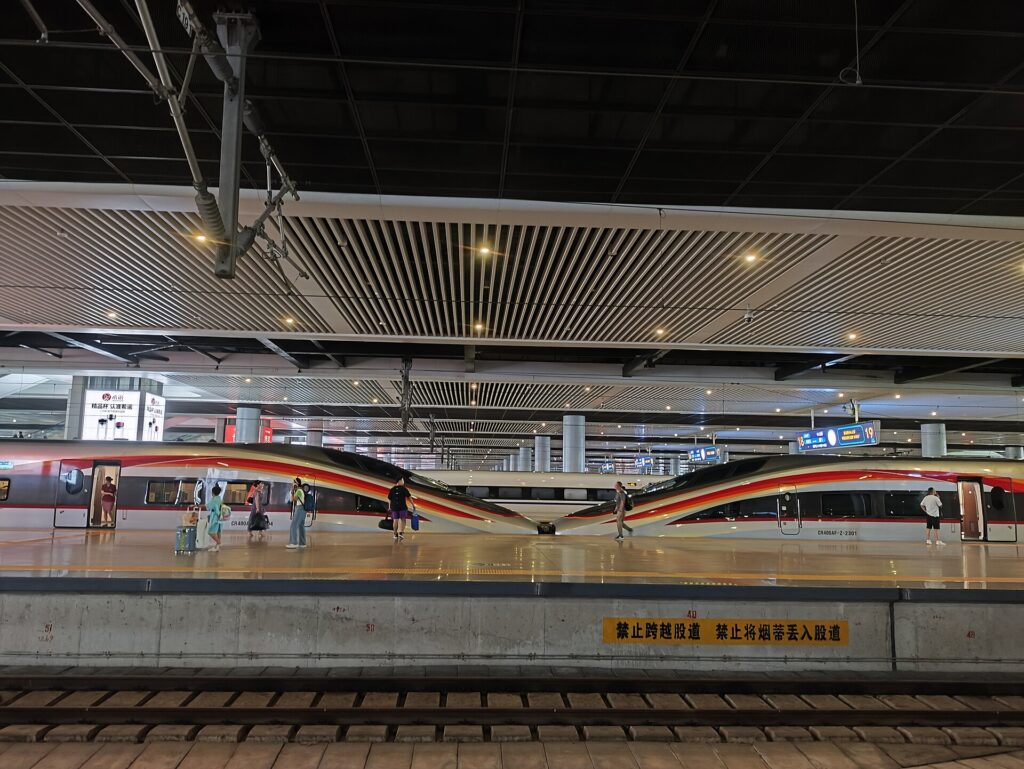
Quick answer: China’s high-speed rail network connects nearly every major first-trip route. The most useful corridors for foreign travelers are Beijing-Shanghai, Beijing-Xi’an-Chengdu, Beijing-Guangzhou-Shenzhen-Hong Kong, Shanghai-Hangzhou-Suzhou, Shanghai-Kunming, and the Guilin-Yangshuo section. Use this guide as a China high-speed train map in words, then confirm the exact train number, station, and travel date on the official 12306 system.
Last reviewed: August 2026. Prices, opening hours and rules can change; confirm the latest details before your trip.
A printed China bullet train map is useful for understanding direction, but it cannot tell you which station a train uses, whether a direct service runs on your date, or whether tickets are available. The practical approach is to understand the main corridors first and use 12306 for the final journey.
China high-speed train map: the main corridors
| Corridor | Major traveler stops | Best use |
|---|---|---|
| Beijing-Shanghai | Beijing, Jinan, Nanjing, Suzhou area, Shanghai | Fastest link between China’s two biggest first-trip cities |
| Beijing-Guangzhou-Shenzhen | Beijing, Zhengzhou, Wuhan, Changsha, Guangzhou, Shenzhen | North-south route and Hong Kong connections |
| Xuzhou-Lanzhou | Xuzhou, Zhengzhou, Luoyang, Xi’an, Lanzhou | Links the eastern network with Xi’an and northwest China |
| Shanghai-Kunming | Shanghai, Hangzhou, Nanchang, Changsha, Guiyang, Kunming | East-west route through major southern cities |
| Coastal network | Shanghai, Hangzhou, Ningbo, Fuzhou, Xiamen, Shenzhen | Coastal cities and Fujian travel |
| Chengdu-Chongqing connections | Chengdu, Chongqing, Xi’an and Guiyang connections | Pandas, Sichuan food, Chongqing, and inland routes |
These corridors overlap through large hubs, so a journey may use more than one line. What matters to a traveler is not the engineering name of the railway but whether the route is direct, which station it uses, and how the schedule fits hotel check-in and sightseeing time.
The six most useful high-speed rail routes for a first China trip
Beijing to Shanghai
This is the country’s best-known high-speed route. Direct G trains make the journey practical as a daytime transfer and usually arrive at Beijing South or Shanghai Hongqiao. The train competes well with flying because both stations connect to city metro systems, while airports add security, weather, and transfer time.
See the full Beijing to Shanghai train guide before choosing a departure.
Beijing to Xi’an
This route connects the capital with the Terracotta Warriors and Shaanxi food. High-speed services generally use Beijing West and Xi’an North. It works well for a two- or three-night Xi’an stop before continuing toward Chengdu or returning east.
Xi’an North is outside the old city center, so include the metro or ride-hailing transfer in your arrival plan. Our Xi’an China travel guide explains how to use the city as a route hub.
Xi’an to Chengdu
The Xi’an-Chengdu link makes it easy to combine northern history with pandas and Sichuan food. This is one of the strongest rail pairings for a first trip because it replaces a more complicated flight day with a city-center-to-city-center journey.
Shanghai to Hangzhou and Suzhou
Both cities are close enough for short rail trips, but they are in different directions and use multiple stations. Do not search only by city name. Check whether your hotel is closer to Shanghai Hongqiao or Shanghai Station and which arrival station gives the easiest local connection.
Guangzhou to Shenzhen and Hong Kong
Guangzhou South and Shenzhen North are major high-speed hubs. Services toward Hong Kong require the correct destination and travel documentation. Allow extra time when an international or border process is involved, and do not assume a metro ride and an intercity railway ride use the same ticket system.
Guilin to Yangshuo
This short rail connection is useful for travelers heading toward karst scenery, but Yangshuo Railway Station is not in central Yangshuo. Plan the final road transfer before boarding. A fast train does not remove the need for a station-to-hotel plan.
How to use the rail network without getting lost
Step 1: search cities, then verify station names
China’s largest cities have several railway stations. “Shanghai,” “Shanghai Hongqiao,” and “Shanghai South” are not interchangeable. The same applies to Beijing, Guangzhou, Shenzhen, Xi’an, and many regional capitals. Search the route, then compare the station names with your hotel and onward transport.
Step 2: identify G, D, and C trains
- G trains: usually the fastest high-speed services on major intercity routes.
- D trains: high-speed or fast electric multiple-unit services, often with more stops or different route patterns.
- C trains: intercity services, often used between nearby urban areas.
The letter is useful, but departure time, station, total travel time, and arrival location matter more than choosing a train only because it begins with G.
Step 3: check the route on 12306
The official 12306 website and app provide live schedules, ticket inventory, station names, and passenger rules. Search your exact travel date. A route that appears on a static China fast train map may not have the same direct departures every day.
Step 4: compare the whole door-to-door journey
A 90-minute train can still consume half a day if the departure station is far from your hotel, security lines are busy, and the destination station is outside town. Compare hotel-to-station travel, recommended arrival time, train duration, and station-to-hotel travel.
Major high-speed rail hubs travelers should recognize
Beijing South and Beijing West
Beijing South is central to many Shanghai-bound services. Beijing West handles many Xi’an and western routes. They are different stations in different parts of the city, so check every booking and ride-hailing destination carefully.
Shanghai Hongqiao
Shanghai Hongqiao combines a large high-speed rail station with airport and metro connections. It is efficient but very large. Keep enough time for the correct entrance, security, and platform.
Guangzhou South
Guangzhou South is a major hub for Shenzhen, Hong Kong, Wuhan, Changsha, and other routes. It is not the same as Guangzhou Station or Guangzhou East. See our Guangzhou South station guide.
Xi’an North
Xi’an North handles high-speed services toward Beijing, Chengdu, Lanzhou, and other cities. It connects by metro but is not beside the Bell Tower or Muslim Quarter.
Chengdu East and Chongqing North
These are key inland hubs. Both cities also have other stations, so the station suffix is essential when arranging a hotel transfer.
Example rail-based China itineraries
Classic 10- to 15-day first trip
Beijing to Xi’an to Chengdu to Shanghai can be built mainly around high-speed rail. Depending on the schedule, the Chengdu-Shanghai leg may be a long train day, so some travelers fly that segment. The network gives you options; it does not mean every possible train is the best use of vacation time.
East China city route
Shanghai, Suzhou, Hangzhou, and Nanjing are well connected. The difficult part is choosing the correct city stations and not changing hotels too often. Base yourself in Shanghai for short trips or move once if you want evenings in another city.
Southern route
Guangzhou, Shenzhen, Hong Kong, Guilin, and Yangshuo can be linked by rail, but the route requires careful station and border planning. It is better to schedule fewer stops than to treat every short line on the map as a separate overnight destination.
Tickets, passports, and boarding
China uses real-name ticketing. Enter passport details exactly as shown and carry the same passport to the station. Foreign passports may use staffed or designated channels when automatic gates do not read the document. Follow station staff rather than repeatedly trying a gate that rejects the passport.
Ticket sales and change rules can change. Use the official 12306 English website for current instructions, and read our 12306 train booking and station guide before purchasing.
If you would rather book through an English interface, Klook sells China high-speed rail tickets for major routes with e-tickets and clear pickup instructions:
Disclosure: This post contains affiliate links. If you buy through them, we may earn a small commission at no extra cost to you. This never affects what we recommend or what you pay. We are not paid to publish positive reviews.
check train availability and book on Klook.Seat classes and luggage
Second class is the normal choice for most travelers. First class provides more space, while business class is significantly more expensive and only makes sense when comfort or work space justifies the price. Choose based on journey length, body comfort, and budget, not on the idea that second class is unsafe or poor quality.
Luggage is carried with you and stored in racks or larger luggage areas. Pack so you can move through security, escalators, and narrow aisles without needing help. Read the China train seat class guide and China train luggage guide for practical details.
Common China bullet train map mistakes
- Assuming every line is direct: some journeys require a transfer even when cities appear connected on a network map.
- Ignoring station suffixes: choosing the wrong station can add an hour across a large city.
- Using old screenshots: new lines and schedules change; verify the travel date on 12306.
- Planning by train time alone: include security, boarding, and local transfers.
- Booking every short segment separately: too many hotel changes can erase the speed advantage.
- Arriving without offline details: save the train number, station in Chinese, departure time, and hotel address.
Frequently asked questions
Where can I find a current China high-speed train map?
Use a recent network map for route orientation, then use the official 12306 website or app for exact trains and dates. Static maps do not show live schedules, ticket availability, or every station used by a service.
Does China’s bullet train network connect all major tourist cities?
It connects most major first-trip cities, including Beijing, Shanghai, Xi’an, Chengdu, Guangzhou, Shenzhen, Hangzhou, Suzhou, Nanjing, Guilin, and many others. Some scenery destinations still require a bus, car, or local train after the high-speed segment.
What is the difference between a bullet train and a high-speed train in China?
Travelers often use both terms for G and D services. In practical trip planning, focus on the train number, total time, departure and arrival stations, and seat class.
Can foreigners book China high-speed trains online?
Yes. Foreign travelers can use the official 12306 English service and other booking platforms. Passenger details must match the passport used for travel.
How early should I arrive at a Chinese railway station?
Allow enough time for the journey to the correct station, security, passport checks, and finding the waiting area. Large stations and holiday periods need more buffer than small stations on quiet dates.
Current maps and official tools
- Official China Railway 12306 English website
- Current China high-speed railway map reference
- Featured image source: Fuxing CR400AF trains, Wikimedia Commons, CC0

Traveling through Guangdong? Read the Shenzhen North high-speed rail hub guide before choosing a Shenzhen departure.
Related China train guides
- How to book high-speed rail tickets in China
- China train e-tickets for foreigners
- Shanghai Hongqiao station guide
- Beijing West station guide
Stay connected during your China trip
Install a China travel eSIM before you fly so maps, payments, transport and messaging apps work the moment you land. Airalo is the simplest option most visitors here start with.