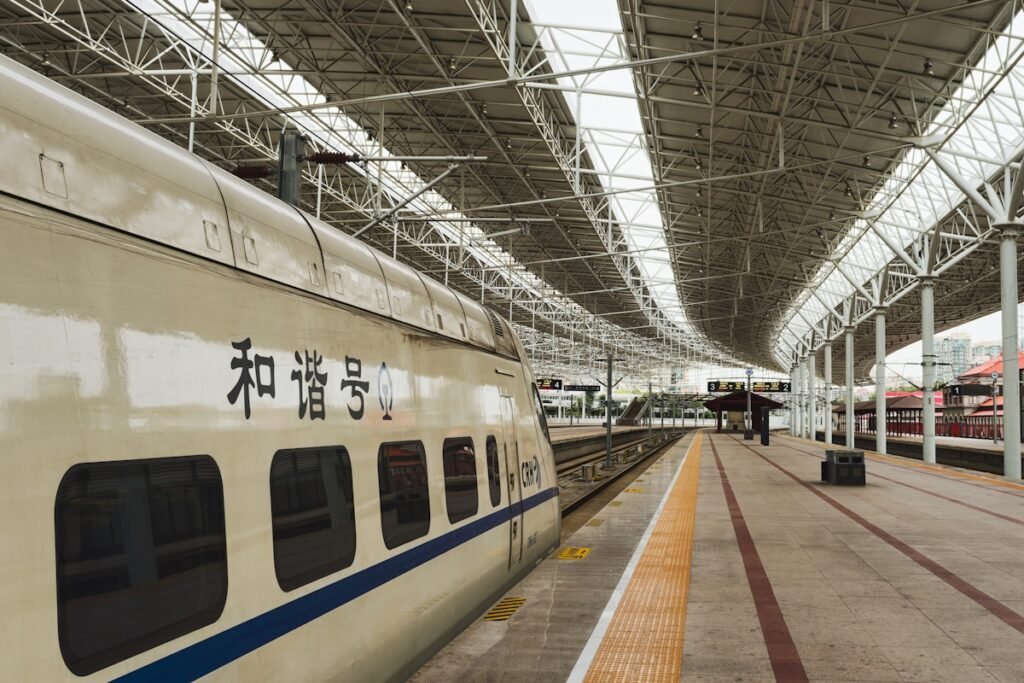
Quick answer: For most foreign travelers, 12306 is the official China train booking system, but it is not always the easiest first choice. Use 12306 if you can complete passport verification in advance and want the official channel. Use Trip.com, Klook, or another English booking service if your trip is soon, your passport verification is not ready, or you want simpler English support. Always check the exact station name and keep your passport with you for boarding.
Why China trains are the best way to travel
China’s rail network is the largest and busiest on earth. Over 45,000 kilometers of high-speed track connect every major city, and trains run at 250–350 km/h with near-perfect punctuality. For foreign travelers, trains are often better than flying: stations are closer to city centers than airports, check-in takes 15 minutes instead of 90, and you actually see the country instead of just clouds. Beijing to Shanghai is 4.5 hours. Shanghai to Hangzhou is 45 minutes. Chengdu to Chongqing is barely over an hour. This guide covers everything a foreigner needs to know about booking, boarding, and riding Chinese trains in 2026 — from 12306 registration to choosing the right seat class.
Before you go anywhere in China, make sure you have a working internet connection. Get an eSIM for China before you fly — you will need internet at the station to show your booking confirmation and navigate with maps.
How to book China train tickets as a foreigner
You have three realistic options for booking train tickets with a foreign passport. Each has trade-offs, and there is no single “best” method for everyone — it depends on how far in advance you are planning and how comfortable you are with Chinese-language apps.
Option 1: Klook (easiest, English interface)
Klook is the easiest option for most foreign travelers. The interface is in English, it accepts international credit cards, and you do not need a Chinese phone number. You pay a small service fee per ticket (usually $3–5), and Klook handles the booking on 12306 behind the scenes. After booking, you receive a PDF confirmation. At the station, go to the manual ticket counter with your passport and the PDF — the staff will print your physical ticket. This is the recommended method for anyone whose trip starts less than two weeks from now, or anyone who does not want to deal with Chinese-language apps.
There is one catch: Klook cannot book every single route. Very short regional trains and some overnight sleepers are sometimes unavailable. For those edge cases, use Trip.com as a backup.
Option 2: 12306 official app (cheapest, but requires setup)
12306 is China Railway’s official platform. It has an English version of the website (12306.cn/en) and a mobile app. The app gives you the best prices and full access to all routes, but there is a registration process that catches many foreigners off guard.
Step 1 — Register: download the 12306 app (search “Railway 12306” in your app store). You will need your passport number, name exactly as it appears on your passport, and a phone number. Your home country phone number works for registration on the English website, but the app sometimes requires a Chinese number — if it does, use the website instead.
Step 2 — Passport verification: this is the bottleneck. After you register, your account needs passport verification before you can book tickets. The verification process takes 3–5 working days. Yes, working days — weekends and Chinese public holidays do not count. If your trip starts in less than two weeks, do not rely on 12306 verification completing in time. Use Klook or Trip.com instead.
Step 3 — Booking: once verified, you can search routes, select trains, choose seat classes, and pay. 12306 accepts international cards through its payment processor, but some foreign banks flag the transaction. WeChat Pay and Alipay are the most reliable payment methods on 12306 — set up Alipay before your trip if you plan to use 12306 regularly.
Step 4 — Collecting your ticket: after booking on 12306, you do not get a PDF or email confirmation. Your booking is linked to your passport number. At the station, go to the manual ticket counter or a self-service machine that supports passport scanning (labeled “护照” — look for newer machines at major stations). Hand over your passport, and the staff prints your ticket.
Option 3: Trip.com (good backup)
Trip.com is the middle ground. English interface, international cards accepted, and it often has routes that Klook does not. The service fee is comparable. Use Trip.com as your backup if Klook does not show the route you need, or if you want to compare prices across platforms.
When to book: how far in advance?
Train tickets in China go on sale 15 days before departure. This is a hard rule — you cannot book earlier. For popular routes during Chinese holidays (Spring Festival in January/February, National Day in the first week of October, Labor Day in early May), tickets sell out within minutes of release. If you are traveling during a Chinese holiday, book through Klook or Trip.com and set a calendar reminder for exactly 15 days before your travel date. Book the moment tickets are released — 8:00 AM China time.
For normal travel dates, 3–7 days ahead is fine for most routes. The busiest routes (Beijing–Shanghai, Shanghai–Hangzhou, Guangzhou–Shenzhen) have frequent departures, so even booking 1–2 days ahead usually works. Regional routes with only a few daily departures should be booked 5–7 days ahead.
Train classes explained: second class, first class, business, and sleepers
Chinese high-speed trains (G-series and D-series) have three seating classes. Regular trains (K-series, T-series, Z-series) have hard seat, soft seat, hard sleeper, and soft sleeper. Here is what each class actually means for a foreign traveler.
High-speed trains (G, D, C trains)
- Second class (二等座): the standard option. Seats are arranged 3+2 across the carriage. Legroom is comparable to an economy airline seat but wider. Power outlets under every seat. Clean, comfortable, and what 90% of travelers use. For trips under 5 hours, second class is perfectly fine. ¥550 Beijing–Shanghai.
- First class (一等座): 2+2 seating, wider seats, more legroom, slightly better recline. About 50% more expensive than second class. Worth it for trips over 5 hours or if you want to work on a laptop. ¥900 Beijing–Shanghai.
- Business class (商务座): 2+1 or 1+1 seating with fully reclining seats, complimentary snacks and drinks, dedicated check-in lane at major stations. Costs about 3x second class. Three seats per row maximum. If you have ever flown business class on a good airline, this is comparable. ¥1,750 Beijing–Shanghai.
Overnight and regular trains (K, T, Z trains)
- Hard seat (硬座): upright benches, no recline, often crowded. Avoid for any trip longer than 2 hours. ¥150 Beijing–Shanghai on a regular train (15 hours, do not do this).
- Soft seat (软座): cushioned seats with some recline. Available on some T and Z trains. Better than hard seat but still do not plan to sleep in one. ¥250 Beijing–Shanghai.
- Hard sleeper (硬卧): six bunks per open compartment (three on each side), no door. The middle and top bunks have less headroom but are cheaper. Bottom bunk has the most space and costs slightly more. Bedding is provided and cleaned between trips. Bring earplugs — compartments are open to the corridor and noise carries. ¥300–350 Beijing–Shanghai.
- Soft sleeper (软卧): four bunks per enclosed compartment with a door that locks. Two upper and two lower bunks per compartment. More space, more privacy, better mattress. ¥500 Beijing–Shanghai. Book these early — there are far fewer soft sleeper compartments than hard sleeper berths, and they sell out first.
- Deluxe soft sleeper (高级软卧): two bunks per compartment with a private sink and sometimes a small sofa. Available on very few routes. The best overnight train experience in China but quite rare — do not count on it being available for your route.
At the station: step-by-step
Chinese train stations are large, modern, and can be overwhelming if you do not know the flow. Here is exactly what to do, in order:
- Arrive 45–60 minutes early. For high-speed trains at major stations, 45 minutes is enough if you know the process. For your first time, give yourself 60 minutes. For regular trains at older stations, 60 minutes minimum.
- Enter through security. All Chinese train stations have airport-style security at the entrance. Put your bags through the X-ray, walk through the metal detector. No need to remove shoes or laptops. Water bottles are fine — you can bring drinks through security.
- Find the departure board. Look for the large LED screens showing train numbers, destinations, departure times, and — critically — the check-in gate number (检票口). Your train will be listed by its train number (e.g., G12, D310). The gate number is often displayed 30–60 minutes before departure. If your train says “候车” (waiting), the gate has not been assigned yet — just wait near the board.
- Go to the manual gate. When your gate opens, do not try the automatic e-gates — they use Chinese ID card scanners that cannot read foreign passports. Instead, look for the manual lane at the far left or right side of the gate area. A staff member will scan your passport or printed ticket and wave you through. There is usually a sign saying “人工通道” (manual channel) or you will see a staff member standing there.
- Find your platform and carriage. After the gate, follow the signs to your platform. Your ticket (or booking confirmation) shows your carriage number (车厢) and seat number. Carriage numbers are displayed on small electronic screens next to each door on the platform. Find your carriage, board, and find your seat.
On the train: what to expect
Chinese high-speed trains are clean, quiet, and well-maintained. Here are a few things to know:
- WiFi: some high-speed trains offer free WiFi, but it requires a Chinese phone number to log in. It is unreliable even when it works. Use your travel eSIM for internet on the train — coverage is good along most high-speed rail routes.
- Food: there is a dining car on most long-distance trains selling hot meals, instant noodles, snacks, and drinks. You can also bring your own food. On high-speed trains, attendants walk through the carriages selling snacks and drinks from a cart. Payment is by WeChat Pay, Alipay, or cash — but cash change is sometimes limited, so mobile payment is easier.
- Bathrooms: high-speed trains have Western-style toilets in at least one bathroom per carriage (usually at one end). Regular trains mostly have squat toilets. Carry your own toilet paper and hand sanitizer — these are not always stocked.
- Luggage: overhead racks above the seats fit standard carry-on suitcases. Larger suitcases go in the luggage racks at the ends of each carriage. There are no formal size or weight limits for carry-on luggage on most trains, but if you cannot lift it onto the overhead rack yourself, pack lighter.
- Smoking: strictly banned on all high-speed trains. The smoke detectors are sensitive and will trigger an emergency stop. On regular trains, smoking is allowed only in the connection areas between carriages.
- Quiet carriages: some high-speed trains now designate certain carriages as “quiet carriages” (静音车厢) where phone calls and loud conversations are discouraged. If you want a quiet ride, look for this option when booking.
Changing or canceling tickets
You can change or cancel tickets through the same platform you used to book. On 12306, changes and cancellations are free up to 8 days before departure. Between 48 hours and 8 days: 5% fee. Between 24 and 48 hours: 10% fee. Within 24 hours: 20% fee. If you booked through Klook or Trip.com, their policies may differ slightly — check before booking. After departure, you can still change to another train on the same day at the station ticket counter, subject to availability.
Common mistakes foreigners make
- Going to the wrong station. Many Chinese cities have multiple train stations. Beijing has Beijing South (北京南), Beijing West (北京西), Beijing (北京), and more. Shanghai has Shanghai Hongqiao (上海虹桥), Shanghai (上海), Shanghai South (上海南). Check the station name on your ticket carefully — “Beijing South” and “Beijing West” are not the same place and are nowhere near each other.
- Assuming passport works at e-gates. It does not. Always look for the manual lane. Attempting the e-gate will hold up the line and you will be redirected anyway.
- Arriving too late. Ticket check-in closes 5 minutes before departure. If you arrive at the station 10 minutes before departure, you are already too late. Unlike airports, train stations do not have “last call” announcements that chase you through the terminal.
- Not having passport name match exactly. Your ticket must show your name exactly as it appears on your passport. Middle names, spaces, hyphens — all of it. If your passport says “JAMES ROBERT SMITH,” your ticket must say “JAMES ROBERT SMITH,” not “James Smith.”
- Forgetting to pick up the physical ticket. If you booked through a third party like Klook and they sent you a PDF, that PDF is not your ticket. You must exchange it for a physical ticket at the station counter. The PDF is a booking confirmation, not a boarding pass.
Recommended routes for first-time visitors
If you are new to China trains, these routes are well-traveled, English-friendly, and logistically smooth:
- Beijing to Shanghai: 4.5 hours, G-series, departures every 30 minutes. The classic China train experience. Both stations are well-signed in English.
- Shanghai to Hangzhou: 45–60 minutes, G-series, multiple departures per hour. Short, easy, and Hangzhou’s West Lake is worth the trip.
- Chengdu to Chongqing: 1–1.5 hours, G-series. Two of China’s most interesting cities, connected by a short, scenic ride through Sichuan’s hills.
- Guangzhou to Shenzhen: 30 minutes, G or C-series. Essentially a commuter route between two massive cities. Good practice run for train newbies.
- Xi’an to Beijing: 4.5–5.5 hours, G-series. See the Terracotta Warriors in the morning and be in Beijing by late afternoon.
12306 China train FAQ for foreigners
Can foreigners use 12306 China train booking in English?
Yes, foreigners can use the 12306 English website for many China train bookings, but passport verification can take time and payment may still fail for some foreign cards. If your travel date is close, use an English booking platform as a backup and keep 12306 as the official reference.
How do I find the right train station in China?
Check the full station name, not just the city. Beijing Railway Station, Beijing South, Beijing West, and Beijing North are different places. Copy the Chinese station name into Amap / Gaode Maps and save a screenshot before leaving your hotel.
Do I need internet at Chinese train stations?
You should plan to have mobile data at the station. You may need it for booking checks, maps, translation, hotel messages, or platform changes. A travel eSIM plus offline screenshots is safer than relying on station Wi-Fi.
The bottom line
China’s trains are one of the best travel experiences in the country — efficient, affordable, and surprisingly easy once you understand the process. Book through Klook if you want the simplest experience, set up 12306 if you are traveling extensively and have time for verification, and always carry your passport. With a working eSIM for internet at stations, Alipay set up for mobile payments, and your booking confirmation in hand, you will be riding China’s rails like a local in no time.
Next steps: Get a China eSIM before your trip so you have internet at every station. Set up Alipay for paying at station shops and on the train. And book your first train ticket on Klook — the English interface makes it by far the easiest option for first-timers.
China Travel Essentials
Everything you need before your first train ride:
- eSIM for China: Compare the best China eSIM plans — you need internet at stations and on the train
- Alipay setup: How foreigners can use Alipay in China — pay for food, drinks, and station purchases
- VPN for China: Best VPNs that work in China — install before you fly
- Book tickets: Klook — English interface, international cards accepted