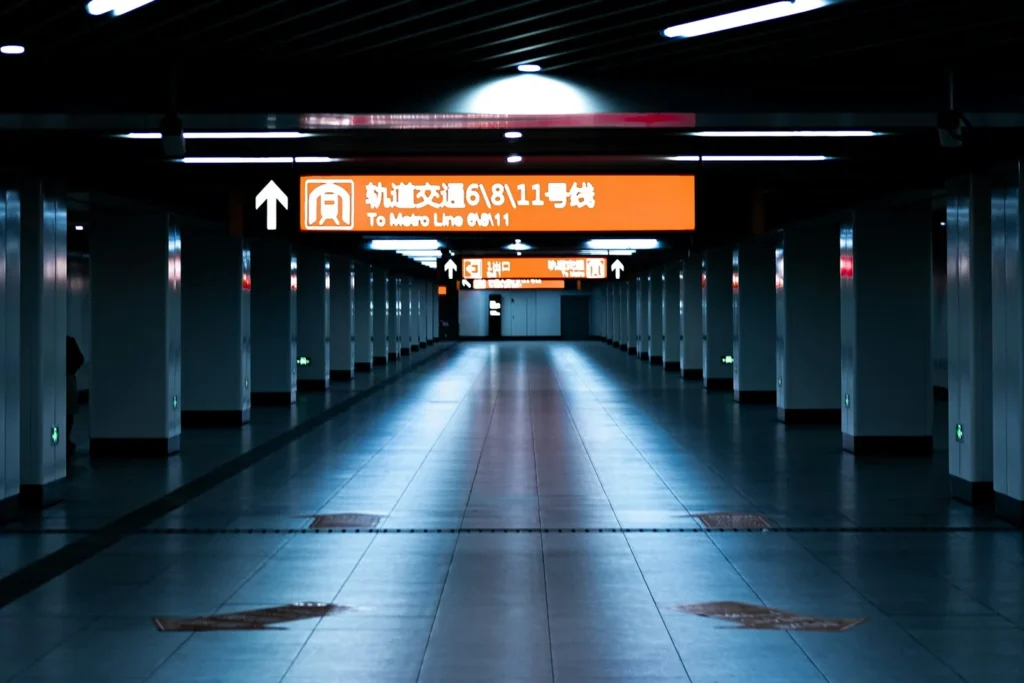
Short answer: China’s subway systems in major cities are clean, efficient, and mostly navigable in English. You can pay with Alipay’s transit QR code, a contactless bank card, or cash at a ticket machine no Chinese phone number or local ID required. The main things to know before your first ride: every station has a security check, signs and announcements are bilingual, and peak hours are genuinely packed. Whether you need the Beijing subway, Shanghai metro, Guangzhou subway, or Shenzhen metro, the basics are similar: security check, station exits, mobile transit QR codes, and a ticket-machine backup.
This guide covers how to pay, how to navigate, what the security check involves, and the small differences between Beijing, Shanghai, and other major city subway systems that matter most for a first-time foreign visitor.
China subway city quick guide
| City | Useful search term | Best payment option | Traveler note |
|---|---|---|---|
| Beijing | Beijing subway | Alipay transit QR or ticket machine | Large stations can have long transfer walks; check the final direction before boarding. |
| Shanghai | Shanghai metro | Alipay transit QR, metro card, or ticket machine | English signs are good and the network is one of the easiest for first-time visitors. |
| Guangzhou | Guangzhou subway map | Alipay or WeChat transit QR, plus ticket machines | Useful for Canton Tower, old city areas, and Guangzhou South Railway Station. |
| Shenzhen | Shenzhen subway map | Alipay or WeChat transit QR, plus ticket machines | Good for Futian, Luohu, Nanshan, and border connections toward Hong Kong. |
How to pay for the subway as a foreigner
There are three ways to pay, and you do not need a Chinese phone number or bank account for any of them. Each works slightly differently depending on the city.
Option 1: Alipay transit QR code (easiest for most visitors)
If you have Alipay set up and working, this is the simplest method. Open Alipay, tap “Transport” or search for the city’s transit card, and a QR code appears. Scan it at the gate to enter, scan again to exit. The fare is automatically deducted from your linked card.
Most major cities including Beijing, Shanghai, Guangzhou, Shenzhen, Chengdu, Xi’an, and Hangzhou support Alipay transit QR. You may need to activate the transit feature for each new city you visit, which takes about 30 seconds in the Alipay app. See the Alipay setup guide for foreigners if you have not set it up yet.
Option 2: Contactless bank card at the gate
Some Chinese cities including Beijing and Shanghai now support tapping an international contactless credit or debit card (Visa, Mastercard) directly at the subway gate. You tap in, tap out, and the fare is charged to your card. This is the newest option and not available in every city or on every gate, but where it works, it is the fastest method for short-term visitors.
Look for gates marked with the contactless payment symbol. If you are unsure, try one marked gate if the light turns green, it worked. If not, use the ticket machine or Alipay QR.
Option 3: Single-journey ticket from a machine
Every subway station has ticket machines with an English language option. Select English, choose your destination station on the map, and pay with cash (RMB notes or coins) or in some cases WeChat Pay or Alipay. The machine prints a small plastic token or card. Tap it at the gate to enter, and insert or tap it to exit.
The main downsides: you need cash (machines may not accept international cards), you must know your destination station name, and during rush hour there can be a queue at the machines. For a single ride, it works fine. For multiple days of subway travel, Alipay QR or a transit card is much faster.
Security checks: what to expect
Every subway station entrance has a security check. You put your bag through an X-ray scanner and walk through a metal detector. The process is usually fast a few seconds if the station is quiet, a few minutes during peak hours. Large stations and interchange hubs have longer lines.
Liquids are generally allowed, unlike at airports. You do not need to remove your shoes, belt, or electronics from your bag. The security check is mandatory and applies to everyone do not try to walk around it.
English signs and announcements
All major Chinese city subway systems have bilingual signs in Chinese and English: station names, exit numbers, line numbers, and direction signs. Onboard announcements are also bilingual the next station is announced in Mandarin then English. Line maps above the doors show the route with English station names.
Smaller cities or newer lines may have less consistent English, but Beijing, Shanghai, Guangzhou, Shenzhen, Chengdu, Xi’an, Hangzhou, Nanjing, and Chongqing all have reliable English signage throughout their networks. If you are visiting a second-tier city, check online before relying on English subway signs.
Navigation tips for first-time riders
- Know your exit. Chinese subway stations often have multiple exits labeled A, B, C, D that can surface blocks apart. Before you ride, check which exit is closest to your destination. Picking the wrong exit can add a 10-minute walk above ground. Use Amap or Apple Maps to find the right exit letter.
- Save station names in Chinese. Even with English signage, station staff and fellow passengers may not understand English pronunciation of station names. Have the station name in Chinese characters on your phone screen.
- Follow the color and number. Each subway line has a color and number. When transferring, follow the signs for your line color and number, not just the destination because a single platform may serve multiple lines.
- Stand on the right side of escalators. Left side is for walking.
- Let passengers exit first. Wait beside the doors and let people off before you board.
Peak hours: when to avoid the subway
During weekday rush hours roughly 7:30 to 9:00 AM and 5:30 to 7:00 PM major interchange stations in Beijing, Shanghai, and Guangzhou can be extremely crowded. Trains arrive full, and boarding can involve being pushed in by the crowd. It is safe but physically intense.
If your schedule is flexible, travel outside rush hours. If you must travel during peak times, avoid the largest interchange stations, keep your bag in front of you, and know your route before you enter the station you will not want to stop and check your phone in the middle of a moving crowd.
City-specific notes
Beijing
Beijing has one of the world’s largest subway networks, covering all major tourist areas and both airports (Capital Airport Express and Daxing Airport Express). The network is easy to navigate with English signs, but lines 1 and 10 during rush hour are among the busiest in China. The Airport Express requires a separate ticket (25 RMB, not included in standard fares).
Shanghai
Shanghai’s metro connects both airports (Pudong and Hongqiao) to the city center, as well as all major tourist areas. The system is well-signed in English and contactless bank card tap-to-pay is widely available. The Maglev train from Pudong Airport is a separate service (not part of the metro) and very fast but expensive for what it is the metro Line 2 is much cheaper, just slower.
Other cities
Guangzhou, Shenzhen, Chengdu, Xi’an, Hangzhou, Nanjing, and Chongqing all have modern subway systems with English signage. The ticket machines, payment methods, and security check process are similar across cities. The main differences are network size and crowd levels Beijing and Shanghai are the busiest.
FAQ
Can I use the subway without a Chinese phone number –
Yes. Pay with cash at a ticket machine, or use Alipay’s transit QR with your international phone number. If your city supports contactless bank card tap-to-pay, you do not even need an app. The basic ride does not normally require a Chinese phone number, but app setup and card verification can still vary by city and by your bank.
Do subway ticket machines have English –
Yes, in all major cities. Look for the language button (usually a flag icon or “English” text) on the machine screen. The English interface lets you select your destination station, see the fare, and pay with cash.
Do I need a transit card, or can I use my phone –
Your phone is enough in most cities if you have Alipay set up. Physical transit cards are available at station service counters but are rarely necessary for short-term visitors. If you are staying more than a week in one city, a transit card can save small amounts of time at the gate.
How much does the subway cost –
Fares are distance-based and inexpensive. A typical ride within a city center costs 3-6 RMB (roughly $0.40-$0.85 USD). Longer cross-city rides and airport express lines cost more. Compared to taxis, the subway is dramatically cheaper.
Are China subways safe –
Yes. China’s subway systems are well-monitored, well-lit, and heavily used by locals at all hours. Violent crime on public transit is rare. The main risks are pickpocketing in dense crowds and physical discomfort during peak-hour crowding. Keep valuables in front pockets and avoid phone use near open doors.
China subway FAQ for foreign visitors
Can foreigners use the subway in China?
Yes, foreigners can use the subway in major Chinese cities without a Chinese ID. The easiest setup is usually Alipay or WeChat Pay with a city transit QR code. If that does not work, use a ticket machine, service counter, or single-journey ticket as a backup.
How do I pay for the Beijing subway?
For the Beijing subway, try Alipay’s transport QR code first. Open Alipay, search for Beijing transit or 北京地铁, activate the card if available, and scan at the gate. If setup fails, buy a single ticket from a machine or ask station staff for help.
Is the Shanghai metro easy for tourists?
Yes, the Shanghai metro is one of the easiest systems in China for tourists. Stations have English names, English announcements, clear transfer signs, and ticket machines. It works well for the Bund, Yu Garden, French Concession areas, Hongqiao, and Pudong airport connections.
More related guides
- Shanghai Subway Map Guide
- Chengdu Subway Map Guide
- Hangzhou Subway Map Guide
- Suzhou Subway Map Guide
- Beijing South Train Station Guide
- Shanghai Railway Station Guide
- Guangzhou South Train Station Guide
- China Train Seat Classes Guide
- China Train Luggage Guide
- China Domestic Flights Guide
Do I need Alipay or WeChat Pay for China subway systems?
You do not always need Alipay or WeChat Pay, because ticket machines and service counters still exist. But mobile payment is much faster, especially if you ride the metro several times a day in Beijing, Shanghai, Guangzhou, Shenzhen, Chengdu, or Hangzhou.
Related high-opportunity guides:
Which app is best for subway navigation in China?
Amap, also called Gaode Map, is the strongest local navigation app for subway exits, walking routes, and real-time directions. Apple Maps can also be useful in major cities. Save your destination in Chinese when possible, because station exits matter a lot in China.
Related route and transport guides:
Related guides
- Amap & Gaode Maps Guide find the right subway exit and plan routes in English
- Set Up Alipay activate transit QR before your first subway ride
- China Without a Chinese Phone Number everything you can do without a local SIM
- China eSIM Guide internet for maps and transit apps
- Chongqing Metro Map for Foreign Visitors: How to Plan a Route
Editor note: transit payment methods, contactless card acceptance, and app features can change and vary by city. This guide reflects information available at the time of writing. Check your destination city’s latest transit information before you travel.
Subway map searches by city
Common metro searches include Beijing subway, Shanghai metro, Guangzhou subway map, Shenzhen subway map, and airport metro routes. The payment method changes by city, but the travel habit is the same: check the final station direction, confirm the exit number, and save your hotel name in Chinese.
Disclosure: This post contains affiliate links. If you buy through them, we may earn a small commission at no extra cost to you. This never affects what we recommend or what you pay. We are not paid to publish positive reviews.
Stay connected during your China trip
Install a China travel eSIM before you fly so maps, payments, transport and messaging apps work the moment you land. Airalo is the simplest option most visitors here start with.