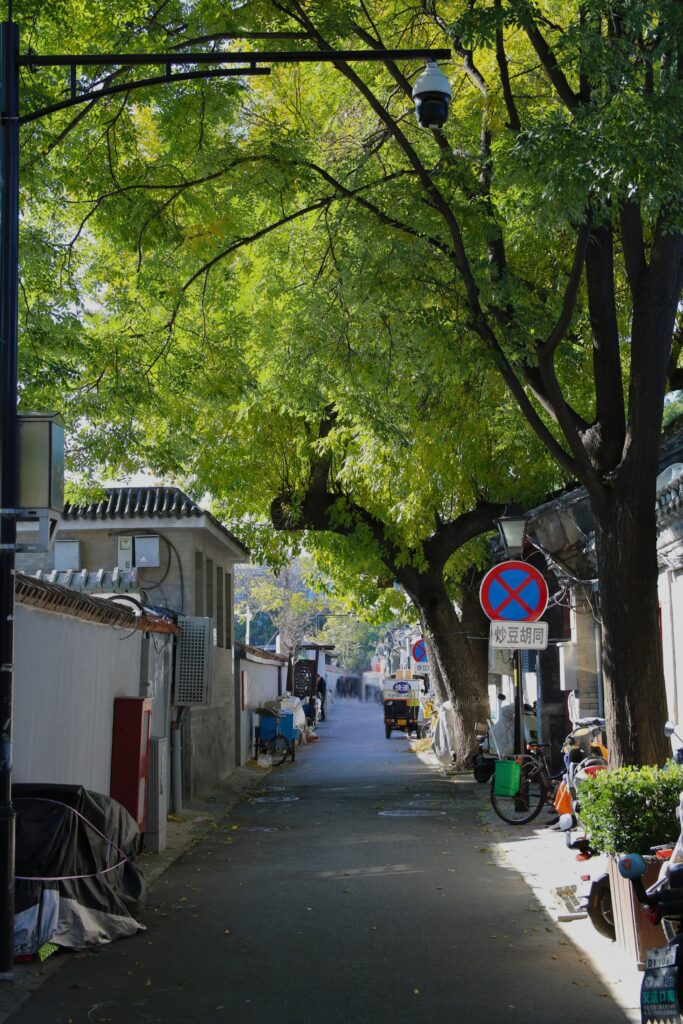
Hutongs are the narrow lanes and alleys of old Beijing, lined with courtyard houses and still full of everyday life. Walking a hutong is not a ticketed attraction — it is walking through somebody’s neighborhood, and that is exactly what makes it worth doing. This guide explains what hutongs are, what kind of visit suits them, where the line sits between public street life and private courtyards, and how to plan hutongs as their own outing rather than a rush between the Forbidden City and the Drum and Bell Towers.
Before you go
A hutong is a narrow street or alley, often only a few meters wide, traditionally lined with courtyard houses whose main doors open directly onto the lane. Networks of these lanes, with their grey walls and tiled rooflines, make up the old street fabric of central Beijing — and people still live in them today.
That single fact should shape your expectations more than anything else. A hutong walk is not a stroll through a museum: within the same half hour you will pass a grocery run, bike repairs, laundry, a school pickup and a street chess game. The right mindset is a quiet guest, not a customer waiting to be entertained.
Bring comfortable shoes and patience. Lanes are narrow, surfaces can be uneven, and there is nothing to “arrive” at — the walk itself is the activity. If you are still planning the rest of your Beijing days, our Forbidden City tickets guide and our Beijing subway guide cover the practical side of moving around the city.
Timing is flexible, since the lanes are public all day, but the feel changes as the day moves on. Early morning brings deliveries, breakfast runs and residents starting their day; late afternoon brings school runs and people heading home. Both are genuine street life. Midday can be quiet, and evenings are calmer still — which is part of the charm, but also a reminder that these are streets where people live, not a stage kept lit for visitors.
Tickets and entry
Walking the hutong lanes themselves is free. Hutongs are public streets, and there is no ticket, gate or official entrance to the lanes as a whole. You can turn into one and walk as far as the lane goes.
What does have rules is everything behind the doors. Some courtyard compounds now operate as museums, guesthouses, shops or cafes and welcome visitors; many more are private homes and are not open to the public. A photogenic doorway is not an invitation. If a place is genuinely open to visitors, it will say so clearly at the door — and any tickets, opening hours or visitor rules for that specific place are set by the venue, so verify them with the venue or through official Beijing tourism channels rather than assuming. The general street character and access described here were last checked against official Beijing city and tourism sources on September 24, 2026.
How to plan the visit
Hutongs suit a particular kind of walk: short, slow and observational. One to two hours of drifting through a few connected lanes, with stops to look at rooflines, door details and street life, is a complete visit for a first-timer. Much more than that and the lanes start to repeat; much less and you only skim the surface.
Rather than following a fixed route, pick a rough cluster of lanes and let the alleys connect themselves. Dead ends are normal and part of the experience; backtracking is fine. Keep to the lanes themselves and the small public spaces along them, and resist the urge to follow a local just because they turned into a doorway — residents have simply gone home.
The boundary to respect is the one between the street and the courtyard. The lane is public: people walking, chatting, trading, playing. The courtyard behind a door is private, even when the door stands open for airflow. Standing quietly in the lane is welcome; stepping through a gateway, photographing into a home or following a resident inside is not.
You do not need a guided tour to walk the lanes, and you do not need to buy anything along the way. If you would rather have context while you walk, reading up on how courtyard houses are laid out beforehand adds a surprising amount: once you can read a gate — its size, its roofline, its thresholds — the lanes stop looking uniform and start telling you who lived where, and the walk becomes far more interesting without moving any faster.
Common mistakes
- Treating residents as photo props. People in a public lane are part of the street, but pointing a camera at a face or through a doorway crosses a line — ask first, or photograph the lane rather than the person.
- Stepping through open gates “just to look”. An open door usually means airflow, not an invitation.
- Assuming every old door leads to an attraction. Most lead to someone’s home.
- Blocking lanes with a group or a photoshoot. Scooters, deliveries and neighbors all need to pass.
- Expecting a performance or a theme-park version of old Beijing. Hutongs are ordinary life in extraordinary surroundings, and the ordinariness is the point.
- Rushing the lanes between two major sights. A hutong visit only works when you slow down; a rushed walk through the lanes misses everything that makes them worth visiting.
What to combine nearby
Hutongs sit naturally alongside Beijing’s big imperial sights, but they ask a different kind of attention, so it pays to give them their own slot rather than treating them as a corridor between monuments.
The Forbidden City and the hutong lanes make a striking contrast in scale — imperial grandeur on one walk, domestic street life on the other — though many travelers prefer to split them across two half-days. The Drum and Bell Towers are often mentioned in the same breath as the old lanes, but they are separate sights with their own visiting arrangements, so treat them as their own stop rather than assuming a hutong walk includes them. Our Temple of Heaven guide and Summer Palace guide cover two more of the city’s classic sights if you are building a fuller Beijing plan. When hunger catches up after a slow walk, our Beijing street food guide covers what to eat and how to order, and our Beijing subway guide covers lines, payment and visitor tips for getting between areas.
FAQ
What exactly is a hutong?
A hutong is a narrow lane or alley in Beijing, traditionally lined with courtyard houses whose gates open onto the lane. Networks of these lanes form the historic low-rise fabric of the old city.
Are Beijing hutongs free to walk?
Yes. The lanes are public streets, so walking them costs nothing and needs no ticket. Anything behind a door — a museum, guesthouse or cafe — is a separate venue with its own rules.
Can I go inside the courtyard houses?
Only if a place is genuinely open to the public, which it will make clear at the door. Most courtyards are private homes, and stepping through a gateway uninvited is not acceptable.
Is it rude to take photos in the hutongs?
Photographing the lanes, walls and rooflines is fine. Photographing residents, or shooting through windows and doorways, is not — ask first if a person is the subject.
How long should a first hutong visit take?
One to two hours is plenty for a first visit. That is enough time to wander a few connected lanes slowly without the experience repeating itself.
Should I visit hutongs and the Forbidden City on the same day?
You can, but the two visits ask for a different kind of attention, so if your schedule allows, giving the hutongs their own quieter slot usually feels more rewarding.