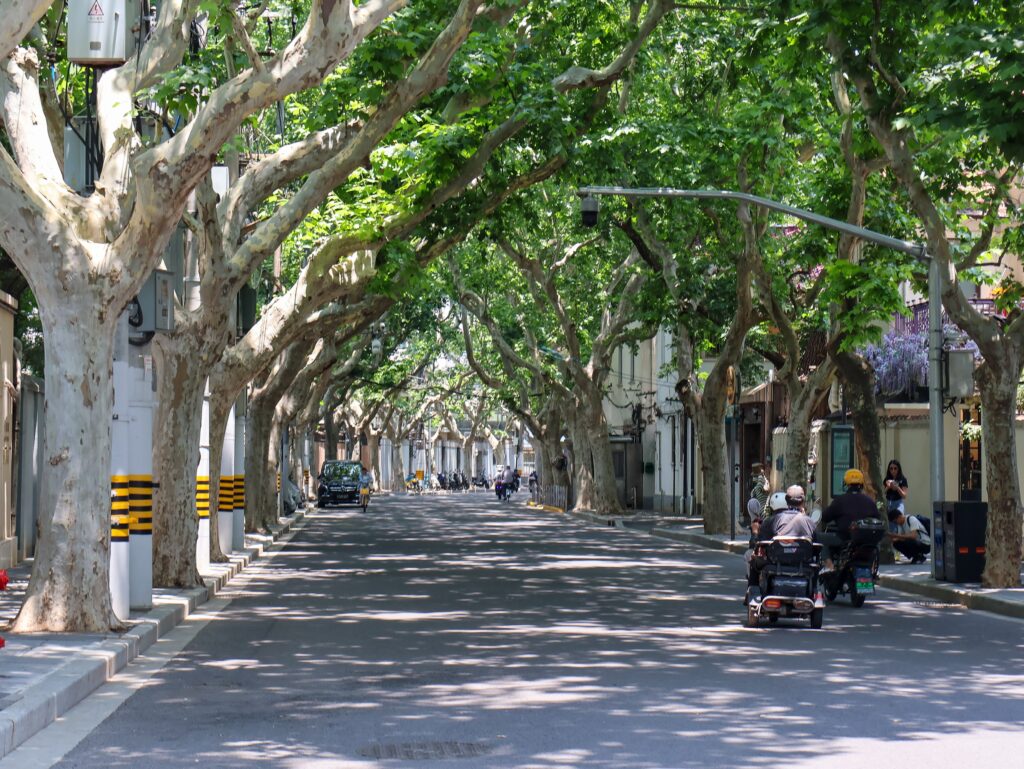
The Shanghai French Concession is a leafy, low-rise district southwest of the Bund, where plane trees close over the streets and early twentieth-century houses sit behind garden walls. It is the calmest well-known area in central Shanghai, and walking through it costs nothing. This guide explains what the former French Concession actually is, who will enjoy it, how to plan a first walk that links the streets together, and why it works better as its own outing than as an add-on to the Bund or Yu Garden.
Before you go
The most useful thing to understand before you set out is that the former French Concession is not a single site. There is no gate, no visitor center, and no boundary line painted on the pavement. Locals and guidebooks use the name as shorthand for a group of adjacent blocks in the older part of the city, and those streets run seamlessly into the neighborhoods around them.
That shape changes how you prepare. Wear shoes you can walk in for a couple of hours, carry water on warm days, and expect shade that comes and goes as the tree cover thickens and thins. The streets are mostly flat and comfortable underfoot, but every corner is a working city corner, with scooters, delivery bikes and normal traffic, so treat the lanes as streets rather than as a promenade closed to cars.
A map app on your phone helps — not to follow a fixed line, but to keep track of where you have drifted and to find your way back to a main road when you are done. If you have not yet sorted out mobile data, payments or maps for China, our Shanghai first-time guide covers the setup that makes this kind of unplanned wandering much easier.
Timing your walk is mostly about light and temperature rather than opening hours. Early starts give you emptier pavements and softer light through the trees, while late afternoon brings long shadows and locals coming home. Midday in warm months can feel heavy, so in summer lean towards morning or evening. In cooler months the area stays pleasant for most of the day, and bare winter branches open up views of the upper facades that dense leaf cover hides in summer.
Tickets and entry
Walking the former French Concession is free. The area is a living neighborhood of public streets, so there is no ticket booth, no gate and no opening or closing time for the district itself. You can step off a main road into a side lane whenever you feel like it, which is exactly the appeal.
Individual places inside the area — small museums, galleries, shops and cafes — set their own hours and entry rules, and some buildings are private homes rather than attractions. Treat any door as private unless a venue clearly invites visitors, and check current details with the venue itself or through official Shanghai tourism channels before you build a plan around one specific building. The street character and public access described here were last checked against official Shanghai city and tourism sources on September 24, 2026.
How to plan the visit
The former French Concession suits travelers who enjoy street-level cities — the people who photograph door frames, rooflines and shopfronts rather than queue for a viewing platform. If that sounds like you, plan the visit as a slow loop rather than a list of stops.
A comfortable first walk takes two to three hours at an unhurried pace, with a break somewhere in the middle. Instead of fixing on one prescribed route, pick a rough line across the area and let side streets pull you sideways. The pleasure of the district is repetition and variation: street after street of mature plane trees, brick and plaster facades, garden walls and small front courtyards. A smaller area walked slowly beats a long route rushed.
Two things are worth keeping straight as you walk. First, the cafes, bakeries and small shops you pass are part of the scenery. This guide does not recommend individual venues — choose whichever looks welcoming at the moment you actually want to sit down, and treat the whole street as the setting rather than the destination. Second, the architecture is there to be looked at from the street. Gateways, tile work, balconies and courtyard entrances all reward attention from the pavement; an attractive gate is not an invitation to step through it.
Direction matters less than you might think. The area is broadly flat, so there is no uphill payoff to plan around — pick a starting point that is convenient for you and let curiosity steer. If you finish earlier than expected, sit for a while rather than marching on. This district rewards people who stop moving as much as people who keep walking.
Common mistakes
- Treating the area as one attraction with an entrance. It is a neighborhood, there is nothing to “arrive” at, and that is normal — judge the walk on atmosphere, not on checkpoints.
- Squeezing it between the Bund and Yu Garden in a single day. The paces do not match, and the area rewards slowness; a rushed walk through quiet streets feels like nothing.
- Peering or taking photos through the windows and doorways of homes. If a door is closed and unmarked, it is somebody’s house.
- Blocking narrow lanes for photos. Residents, neighbors and delivery scooters all use these streets every day.
- Expecting a themed “French village”. This is a Chinese city neighborhood whose street fabric dates from the concession era — everyday life first, heritage as the setting.
What to combine nearby
The former French Concession pairs naturally with the rest of central Shanghai, but it is worth resisting the urge to stack everything into one day. Two relaxed half-days feel much better than one long day.
The Bund is the classic pairing and the sharpest contrast: riverside skyline on one outing, shaded residential streets on the other. Our Bund walking guide covers timing and the river side. Yu Garden sits at a different register again — a classical garden and bazaar quarter — and our Yu Garden guide covers tickets and timing. For moving between areas without memorizing stops and exits, our Shanghai subway guide covers the lines, payment and the routes visitors actually use.
FAQ
Is the Shanghai French Concession free to visit?
Yes. The former French Concession is a neighborhood of public streets, so walking through it is free, with no ticket and no opening hours for the area itself. Individual venues inside set their own rules.
Where does the French Concession start and end?
There is no fence and no official boundary. Locals use the name for a group of adjacent blocks southwest of the Bund, and the streets blend into the surrounding neighborhoods. Pick a general direction rather than a fixed edge.
How long should a first walk through the French Concession take?
Two to three hours is comfortable for a first visit, including a break. You can walk longer by adding side streets, but a shorter slow loop usually feels more rewarding than a long rushed one.
Can I see the French Concession and the Bund on the same day?
You physically can, and many travelers do. But the two areas have different rhythms, so if your schedule allows, giving each its own half-day usually feels far less rushed.
Do I need to book anything in advance for the French Concession?
No, not for walking the streets — there is nothing to book. Individual museums, galleries or venues inside the area may have their own tickets or time slots, so check with the venue directly if you plan to enter one.
Is the French Concession area good for a slow morning?
Yes. The tree shade, quiet side streets and street-level scenery make it a natural slow-morning area. Mornings are also cooler in warm months and generally quieter than midday.