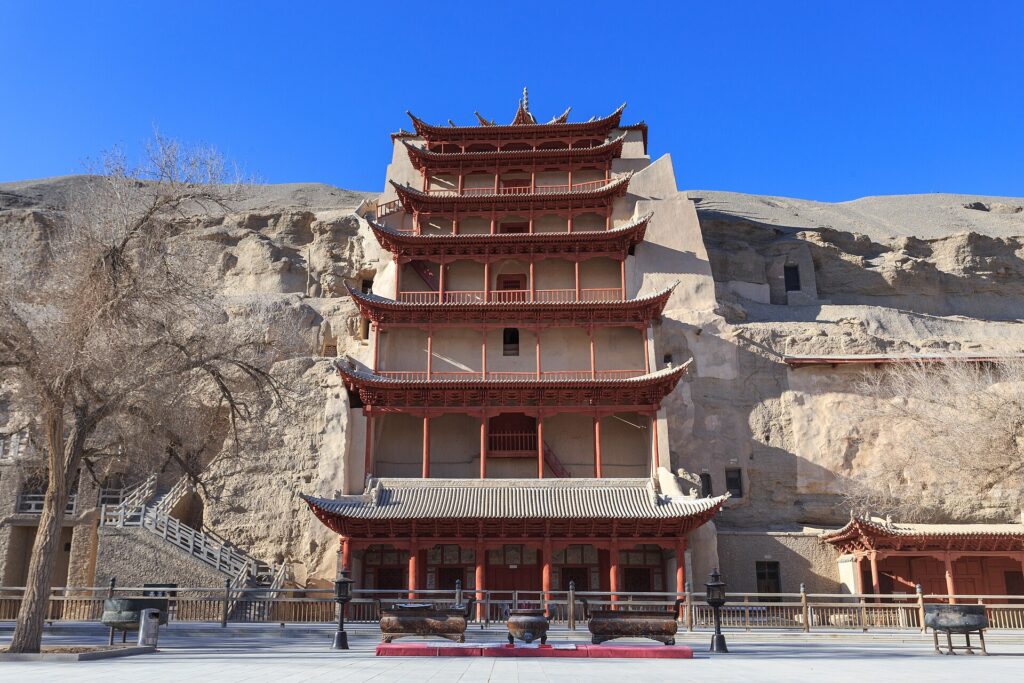
Short answer: Mogao Caves in Dunhuang is a cliff-side complex of Buddhist cave temples with over 1,000 years of murals and sculptures, and it is one of the most impressive sights in northwest China. Book a timed ticket in advance, allow 3–4 hours for the visit, and pair it with Mingsha Mountain and Crescent Lake for a classic one- or two-day Dunhuang plan.
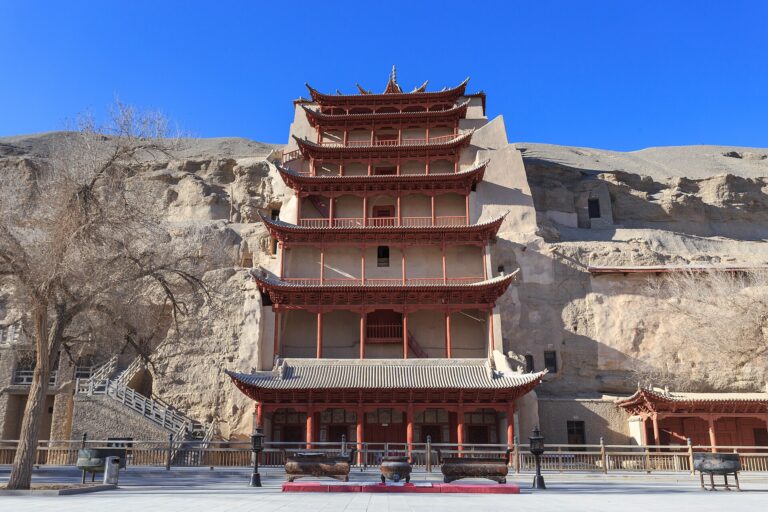
Quick answer: The Mogao Caves at Dunhuang are a UNESCO World Heritage site of hundreds of cliff-side Buddhist cave temples on the old Silk Road, with paintings and sculptures spanning the 4th to 14th centuries. Tickets are limited and timed, so book in advance. Most first-time visitors spend 1-2 hours on a guided cave tour, then pair it with Mingsha Mountain and Crescent Lake.
Why travelers visit Dunhuang
Dunhuang sits at the western edge of Gansu Province on the old Silk Road. For most visitors the reason to come is simple: the Mogao Caves, a UNESCO World Heritage site where Buddhist art was painted and carved almost continuously from the 4th to the 14th century. Unlike a museum, the caves are still a living archaeological site, and you visit them in small guided groups with an official tour guide.
Dunhuang is also the most practical base for the desert scenery around Mingsha Mountain, Crescent Lake, and the western Silk Road sites such as Yumen Pass. Most people spend two nights here: one day for the caves, and one day for the desert and nearby ruins.
Mogao Caves: what you actually see
The Mogao Caves are not one giant hall. They are 735 caves cut into a cliff, of which a rotating selection of roughly 8–12 caves is open to visitors each day. The number and exact caves depend on the date, weather, and the current conservation program, so no two visits are identical.
The highlights travelers are most likely to see include:
- Cave 96 – the giant Buddha: a 35-meter-tall seated Buddha, one of the largest in China, housed inside the iconic nine-story wooden facade.
- Cave 16 and 17 – the Library Cave: the famous hidden chamber where tens of thousands of manuscripts were discovered in 1900.
- Cave 148 – the sleeping Buddha: a huge reclining Buddha representing nirvana, surrounded by murals of mourners.
- Murals in caves such as 61, 220, and 428: flying apsaras, trade routes, court scenes, and early Buddhist stories that survive in remarkably vivid color.
Before entering the cave zone, every visitor watches two short films at the Digital Exhibition Center: one about the Silk Road and one immersive dome film about the caves. You are then shuttled to the caves, where a guide leads the group cave by cave with a flashlight. The whole program usually takes 3–4 hours.
Mogao Caves tickets, tours, and rules
| Item | What you need to know |
|---|---|
| Tickets | Buy in advance through the official WeChat mini-program for Dunhuang cave reservations or a reliable third-party platform. Passport details are required for the real-name system. |
| Visit length | Plan 3–4 hours including the two films, shuttle, and guided cave tour. |
| Photography | No photos or video inside the caves. You can take photos of the exterior, the nine-story building, and the surrounding desert landscape. |
| English support | Official guides lead groups in Chinese; English audio guides and English guided options are available but limited, so a tour platform with an English-speaking guide is a reliable backup. |
| Peak season | Summer and Chinese holidays are busy; tickets can sell out days ahead. Book as early as possible and do not rely on same-day entry. |
If booking feels complicated from outside China, an English-speaking tour that includes transport and tickets is the easiest route:
Disclosure: This post contains affiliate links. If you buy through them, we may earn a small commission at no extra cost to you. This never affects what we recommend or what you pay. We are not paid to publish positive reviews.
compare Dunhuang tours and tickets on Klook.Mingsha Mountain and Crescent Lake
About 6 km from Dunhuang city center, Mingsha Mountain (“Singing Sand Dunes”) rises beside Crescent Lake, a small spring-fed lake shaped like a half moon. The classic visit is late afternoon: walk or ride a camel up the dunes, watch the sun drop behind the desert, and then walk down to the lake. Camel rides are managed in convoys and are easy to book at the entrance or with a tour.
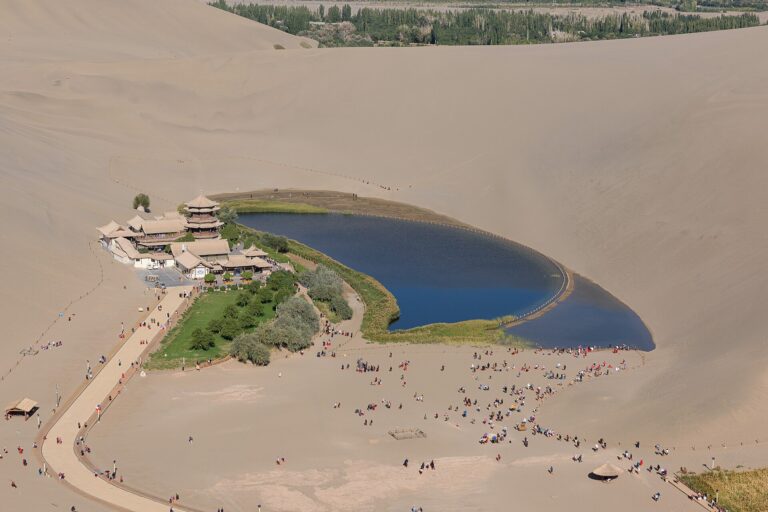
- Best time: late afternoon for light and temperature; sunrise also works for photographers.
- Time needed: 3–4 hours including the camel ride and the walk around the lake.
- Bring: sunglasses, a scarf or mask for windblown sand, and water. Shoes will get sand in them no matter what you do.
- Night show: there is a large evening sand-dune show at the scenic area; it is impressive but separate from the natural sunset visit.
How to get to Dunhuang and between the sights
Dunhuang has its own airport (DNH) with direct flights from Beijing, Xi’an, Lanzhou, Shanghai, and other cities, plus a high-speed rail connection via Lanzhou and Zhangye. From the airport or the train station, the caves are roughly a 30-minute drive and the city center about 20 minutes. A pre-booked private transfer removes the usual taxi-haggling step: book a Dunhuang airport or station transfer with Kiwitaxi.
Most visitors combine Dunhuang with a Silk Road route through Lanzhou, Zhangye, and Jiayuguan. Our Gansu travel guide explains the full route, and the Zhangye Danxia guide covers the rainbow mountains one rail stop away.
One-day or two-day plan?
| Option | Route | Good for |
|---|---|---|
| One full day | Morning Mogao Caves, late afternoon Mingsha Mountain and Crescent Lake, evening Shazhou Night Market. | Tight schedules with only one night in Dunhuang. |
| Two days | Day 1: Mogao Caves plus Shazhou Night Market. Day 2: sunrise or sunset at Mingsha, then Yumen Pass and the western desert route if you have a car or tour. | Most comfortable pace and covers the Silk Road ruins. |
If you only have one day, do not try to add the western ruins. The caves and the desert are already a full, rewarding day.
When to go and what to bring
The best months for Dunhuang are May–June and September–October: warm days, cool evenings, and clear desert light. July–August is hot and crowded; winter is cold but the caves are quiet and the low sun can be beautiful. Summer visitors should bring sun protection, while spring visitors may meet dusty wind. You need your passport for the real-name ticket check, comfortable walking shoes, and layers because the desert cools quickly after sunset.
Mobile signal is fine in Dunhuang, but prepare your apps before the trip: our eSIM setup guide and Amap guide cover the two tools that make a remote city easier.
FAQ
Are the Mogao Caves worth visiting?
Yes. The caves are the single most important reason to travel to Dunhuang, and the murals and sculptures have no close equivalent elsewhere in China.
How do I book Mogao Caves tickets?
Book in advance through the official Dunhuang cave reservation WeChat mini-program or a third-party platform, using the passport details exactly as they appear on your passport. Tickets are tied to a date and entry time.
Can I take photos inside the Mogao Caves?
No. Photography and video are not allowed inside the caves. You can photograph the exterior, the nine-story building, and the surrounding scenery.
How long do I need at the Mogao Caves?
Allow 3–4 hours for the two films, the shuttle, and the guided cave visit. Do not plan anything immediately after that is time-sensitive.
Should I also visit Mingsha Mountain and Crescent Lake?
Yes. The dunes and lake are only a short drive from the city and make a natural pairing with the caves. Late afternoon is the best time for light and temperature.
Related China travel guides
- Gansu travel guide: the full Silk Road route
- Zhangye Danxia rainbow mountains guide
- 30-day China itinerary that includes Dunhuang
- Terracotta Warriors guide for Xi’an
- How to book high-speed rail tickets in China
Stay connected during your China trip
Install a China travel eSIM before you fly so maps, payments, transport and messaging apps work the moment you land. Airalo is the simplest option most visitors here start with.