
Quick answer: Your first day in China goes smoothly when you land with working data, a payment app, offline maps and your hotel address written in Chinese. This arrival-day guide covers exactly what to set up before you fly, what to do at the airport and after arrival, and how to stay connected from the moment you land.
Disclosure: This post contains affiliate links. If you buy through them, we may earn a small commission at no extra cost to you. This never affects what we recommend or what you pay. We are not paid to publish positive reviews.
Be ready before your first day
Before you leave the plane: what to have ready
Keep these items in your hand luggage, not in the overhead bin: your passport, a printed copy of your hotel address in Chinese characters, a pen (for the arrival card), and your phone (charged). Download offline Google Maps of the city you are landing in before departure. Take a screenshot of your hotel’s name in Chinese and its phone number. If you have an eSIM, make sure the profile is installed — you will activate it when you land. If you bought a VPN, install and test it before departure; you cannot download VPN apps after you land because the app stores are blocked on airport WiFi.
Immigration: the arrival card and what the officer asks
On the plane or at the immigration hall, you will fill out an arrival card. You need: your passport number, flight number, visa number (if applicable), and the address of where you will stay in China. Write the hotel address exactly as it appears on your booking — in Chinese characters if possible, but English is accepted. At the immigration desk, the officer will scan your passport, take your photo, and may ask: ‘How long will you stay?’ — answer with the number of days. ‘Where will you stay?’ — show your hotel address. ‘What is the purpose of your visit?’ — say ‘Tourism.’ They rarely ask more than these three questions. The process takes 2–5 minutes if everything is in order.
Step 1: Get online immediately
This is the most important step. Without internet, you cannot use maps, translation apps, or any digital payment. If you bought a travel eSIM: go to Settings → Cellular → turn ON the eSIM line → turn ON data roaming → wait 1–3 minutes for connection. If you have not bought an eSIM yet, Airalo has instant delivery — you can buy one on airport WiFi and install it in 5 minutes. If you did not buy an eSIM: connect to airport WiFi (most Chinese airports have free WiFi, but you need a phone number to receive an SMS code — your home SIM with roaming enabled works for this). If no eSIM and no roaming: go to the airport SIM card counter. China Mobile, China Unicom, and China Telecom all have airport desks. A tourist SIM costs RMB 100–200. You need your passport. The staff will set it up.
Step 2: Get cash while you are at the airport
Before leaving the airport, withdraw RMB 300–500 from an ATM. Bank of China (BOC) and Industrial and Commercial Bank of China (ICBC) ATMs are the most reliable for foreign cards. Look for the Visa/Mastercard logo on the ATM. Do not use Euronet or other independent ATMs — their fees are higher and their exchange rates are worse. Decline the ATM’s offered exchange rate (choose ‘without conversion’ or ‘continue without conversion’) — your home bank’s rate is almost always better. If the first ATM rejects your card, try a different bank’s ATM. Take the cash even if you plan to use Alipay for everything — you will need it when a small vendor’s QR code rejects your foreign card, which happens more often than travel blogs admit.
Step 3: Get to your hotel
You have four options from the airport.
Taxi: follow signs to the official taxi queue, not the touts inside the terminal. Have your hotel address in Chinese characters to show the driver. A taxi from PEK (Beijing) to the city center costs about RMB 100–150. From PVG (Shanghai Pudong) about RMB 150–200. Pay with cash if Alipay is not set up yet.
Official taxi or pre-booked transfer: use the airport taxi queue or a hotel-arranged transfer when metro is inconvenient.
Metro: Beijing and Shanghai airports have metro connections. The Airport Express in Beijing costs RMB 25 and takes about 30 minutes to the city center. Good if you are traveling light and your hotel is near a metro station.
Airport bus: cheaper than taxi, drops you at major hotels and transport hubs, takes longer.
Step 4: Check into your hotel
When you arrive at the hotel, you need: your passport (the hotel will scan it and register you with the local police — this is required by law), your booking confirmation (printed or on your phone), and a payment method (international credit cards work at most hotels). After check-in, ask the front desk for: a business card with the hotel’s name and address in Chinese (keep this in your wallet — it is the single most useful item you will have for the rest of the trip), the WiFi password (most Chinese hotels have good WiFi), and the nearest metro station name (in Chinese). Before going to your room, test your Alipay: walk to the nearest convenience store (FamilyMart, 7-Eleven, or a local shop), buy a bottle of water, and pay with Alipay. If it works, you are ready. If it does not work, you still have the cash from the airport.
Step 5: Do these 3 things in the first 2 hours after check-in
1) Download or confirm your eSIM is working. Turn off WiFi temporarily and test that your phone loads Google.com over cellular data.
2) Open Amap (Gaode Maps) and save your hotel as a favorite. Test that it correctly navigates to the nearest metro station.
3) Walk around your hotel neighborhood for 15 minutes. Find the nearest convenience store, the nearest metro entrance, and a restaurant that looks busy with locals. This 15-minute walk solves 80% of first-day stress because you now know where to get water, how to get around, and where to eat.
What to do if everything goes wrong
If your eSIM will not connect, your cards are all declined, and you are standing in the airport with no plan: stay calm. Go to the airport information desk and ask for a SIM card shop — every major Chinese airport has one. Buy a physical SIM with cash (exchange money at the airport currency exchange first if needed). Connect to airport WiFi to message your hotel. Take a taxi to your hotel using the address in Chinese. Once at the hotel, use hotel WiFi to troubleshoot everything else. The hotel front desk can help you call your bank if needed. You are not the first foreigner to arrive unprepared, and you will be fine.
Essential Tools for Arrival Day
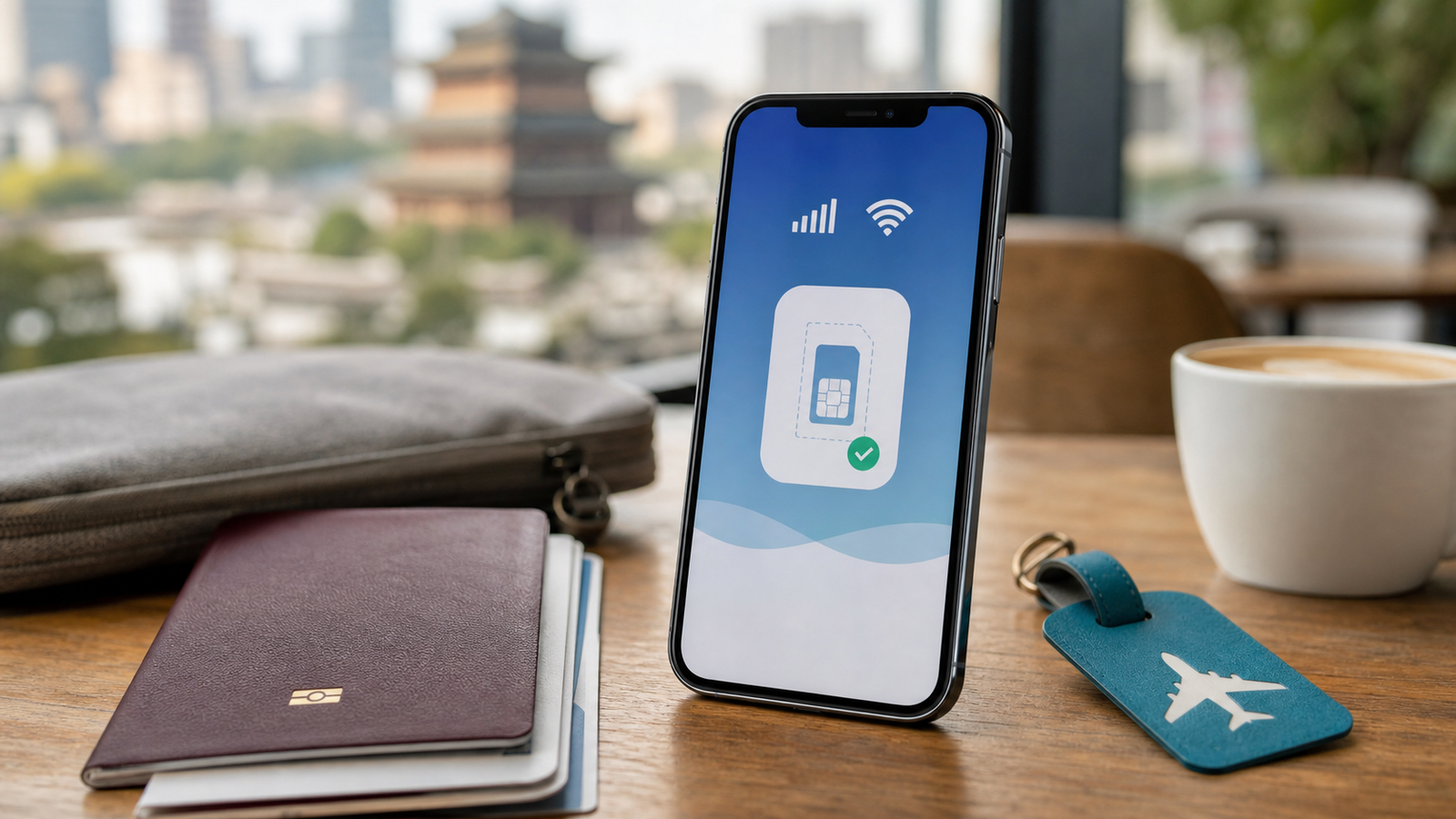
Airalo China eSIM
Internet from landing
- Install before departure
- Useful for maps and payments
- Simple first-hour setup

Klook
Tickets and day tours
- Attraction and transfer options
- Useful English booking flow
- Good first-trip planning backup
Arrival-day searches
Arrival-day searches often include China airport transfer, eSIM not working, Alipay setup, hotel check-in, passport registration, taxi apps, metro from airport, and how to use maps in China. Keep the first three hours simple: get connected, reach the hotel, then solve food and payment after bags are safe.
After landing, check whether the airport metro or subway from the airport is easier than a taxi for your hotel location.
Related China internet and map guides: