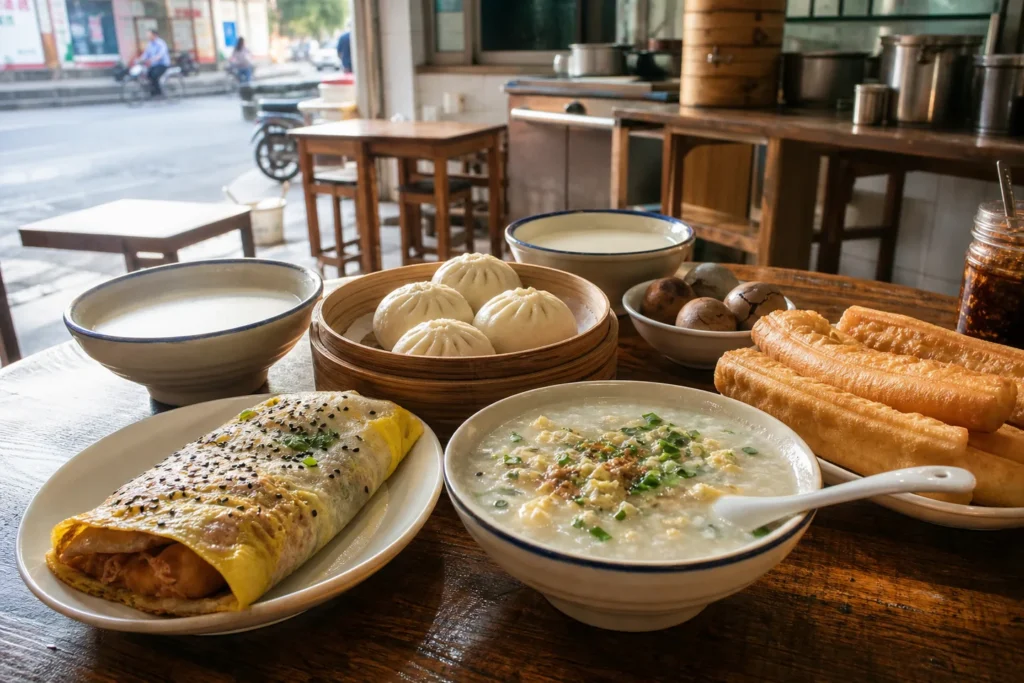
Quick answer: A typical Chinese breakfast includes savory options like jianbing (crispy crepe with egg), baozi (steamed buns), youtiao (fried dough sticks) with soy milk, congee (rice porridge), and tea eggs – found at street stalls, small shops, and hotel buffets across the country. Most of it is not spicy, often costs around RMB 5-15, and is easy to order by pointing. What do Chinese people eat for breakfast? The answer varies by region, but these foods are common in many cities.
This guide covers the most common Chinese breakfast foods, how to find them, how to order without speaking Chinese, and what to expect at hotel buffets versus street stalls.
Most common Chinese breakfast foods
Jianbing (煎饼果子) – One of the most recognizable street breakfasts in northern China. A vendor spreads thin batter on a hot griddle, cracks an egg on top, and folds it around a crispy cracker with sauce. Savory, slightly spicy, often costs RMB 7-12. Order by pointing and holding up one finger. Best for a quick breakfast eaten while walking.
Baozi (包子) – Steamed buns filled with pork, vegetables, egg, mushrooms, or red bean paste. Common in many cities. Sold by the basket (笼) or by the piece, depending on the shop. A simple serving often costs RMB 6-12. Not spicy. Point at the steamer and say “yī lóng” (一笼) if the shop sells baskets.
Youtiao (油条) and soy milk (豆浆) – Deep-fried dough sticks served with warm soy milk. You dip the stick in the milk to soften it. Costs about RMB 5-8. Available at any breakfast shop – look for the steaming pots out front. Easy to identify and order since you can see the golden sticks in the window.
Congee (粥) – Rice porridge with pickled vegetables, salted duck egg, or pork floss. Mild, good for light eaters. Ask for “báizhōu” (白粥, plain) and add toppings yourself. Costs RMB 3-8.
Noodles (面条) – Common for breakfast in Xi’an, Lanzhou, and Chengdu. A bowl of beef noodle soup or hot dry noodles costs RMB 8-20. Most visitors save noodle-heavy meals for lunch, but it is a normal breakfast option in central and western China.
Tea eggs (茶叶蛋) – Hard-boiled eggs steeped in tea and soy sauce. Sold at convenience stores for RMB 2-3 each. Mild, not spicy, good for a quick protein addition.
Where to find breakfast as a tourist
Street stalls: Look for carts with steam and a local queue. Jianbing, baozi, youtiao, soy milk. Mobile payment is common, but carrying small cash as a backup helps. Pointing works. See our Alipay guide for mobile payment options.
Breakfast shops: Small sit-down shops with plastic stools. Baozi, congee, noodles, youtiao. Order at the counter. Signs say “早餐” or “早点”. RMB 5-15 per person.
Hotel buffets: Most mid-range hotels include Chinese and Western options. Good place to try things without ordering pressure. If unsure about street food, start here.
Convenience stores: 7-Eleven, FamilyMart sell steamed buns, tea eggs, sandwiches, hot soy milk. Accept mobile payment. See our QR code guide for payment tips.
Frequently asked questions about Chinese breakfast
What do Chinese people eat for breakfast?
Jianbing, baozi, youtiao with soy milk, congee, noodles, and tea eggs. A traditional Chinese breakfast is savory, not sweet, and costs RMB 5-20. Regional variations exist but these are common nationwide.
Is Chinese breakfast food spicy?
Most Chinese breakfast foods are not spicy. Jianbing has mildly spicy sauce – ask for “bú là” (不辣) to skip it. Baozi, congee, youtiao, and tea eggs are all mild.
Where can I find breakfast near my hotel in China?
Search “早餐” on Amap for nearby shops. Street stalls and breakfast shops are within 5 minutes of most hotels. Hotel buffets are reliable if you want variety without language barriers. See the China Food Guide for more tips.
How much does a typical Chinese breakfast cost?
Street breakfast: RMB 5-15. Breakfast shop: RMB 10-20. Hotel buffet: usually included with the room, or RMB 30-80 as walk-in. Chinese breakfast is very affordable.
Can I find Western breakfast in China?
Yes – hotel buffets include Western options. Bakeries and cafes in major cities serve coffee and pastries. For a more local experience, try the Chinese options – they are fresher, cheaper, and part of traveling in China.
Related food guides:
Related Guides
- China Food Guide
- China Food Streets and Night Markets
- How to Use Alipay in China
- QR Codes in China
- First Trip to China
How to find breakfast near your hotel
The easiest method is to open Amap in the morning and search for breakfast, baozi, congee, jianbing, or soy milk near your hotel. If you do not want to type Chinese, walk toward metro exits, schools, office streets or residential blocks between 7:00 and 9:00 AM. A small queue is usually a better signal than a fancy sign.
Regional breakfast differences
| Region | Common breakfast feel | Examples |
|---|---|---|
| North China | Wheat-based, hot, filling. | Jianbing, baozi, youtiao, soy milk, noodles. |
| Shanghai / Jiangnan | Dumplings, buns, soy milk, noodles and lighter snacks. | Xiaolongbao, shengjianbao, wontons. |
| Guangdong | Dim sum and rice/noodle dishes are more important. | Congee, rice rolls, buns, tea-house breakfast. |
| Sichuan / Chongqing | Noodles and spicy options appear earlier. | Small noodles, wontons, spicy noodle bowls. |
Breakfast ordering tips
- Pointing is normal at small breakfast stalls.
- Buy one or two items first, then order more if you like it.
- Hot soy milk may be sweet or unsweetened depending on shop.
- Jianbing is best eaten immediately while crisp.
- Hotel breakfast is easier, but street breakfast teaches you more about daily China.